
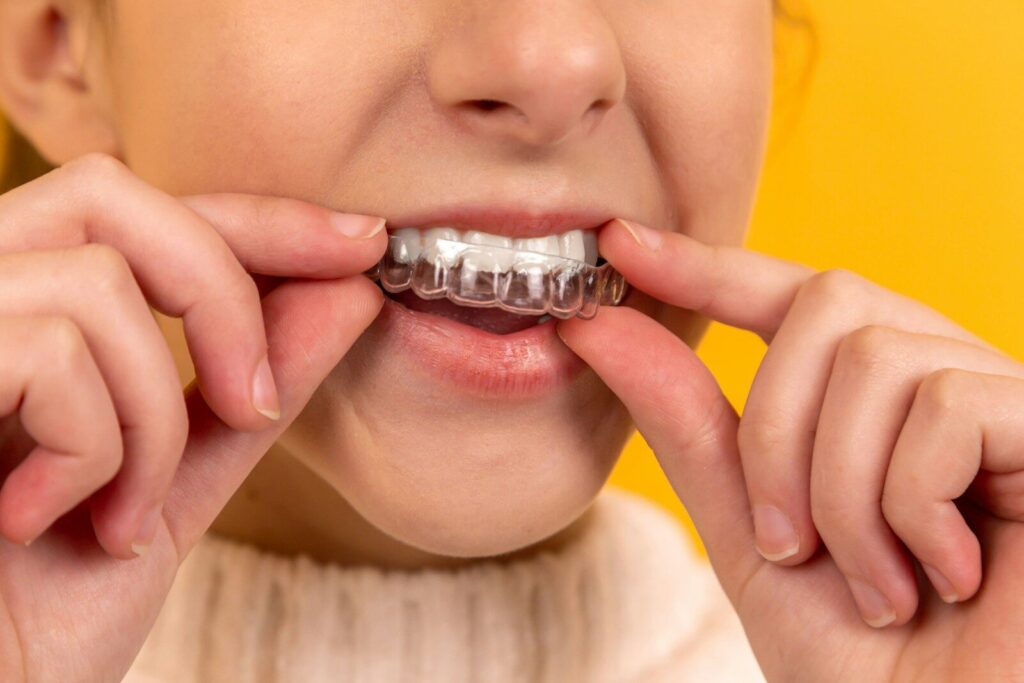
If you have been thinking about straightening your teeth, you have likely already encountered the big question: clear aligners or traditional braces? Both options work. Both have real advantages. And the right answer genuinely depends on your teeth, your lifestyle, and your goals.
This guide breaks down everything you need to know so you can walk into your consultation at Winyah Dental Group with a clear picture of what to expect from each path.
How each option works
Before comparing the two, it helps to understand what each treatment actually does.
Traditional braces
Metal braces use a system of brackets bonded directly to each tooth, connected by a wire that your orthodontist or dentist tightens at regular appointments. That tension gradually shifts teeth into their correct positions over time. Traditional braces have decades of clinical data behind them and can address a very wide range of alignment issues, from mild crowding to complex bite corrections.
Clear aligners
Clear aligners use a series of custom-made, removable plastic trays that are worn over your teeth. Each tray is slightly different from the last, progressively moving your teeth toward the desired position. At Winyah Dental Group, we use ClearCorrect aligners — a system designed for controlled single-tooth movement with remote monitoring options, so your progress can be tracked between visits.
Appearance: the most obvious difference
For most adults and older teens considering orthodontic treatment, appearance is the deciding factor that gets them in the door — and it is where clear aligners have a clear advantage.
ClearCorrect trays are nearly invisible when worn. Unless someone is looking closely, most people will never notice you are in treatment. Traditional metal braces, by contrast, are visible and noticeable — which for some patients is a real concern in professional settings, social situations, or for confidence reasons.
Ceramic braces exist as a middle-ground option (tooth-colored brackets instead of metal), but they are still fixed to the teeth and more visible than clear aligners.
If discretion matters to you, clear aligners win this category outright.
Comfort and day-to-day experience
Both treatments involve some discomfort, particularly in the first few days after an adjustment or tray change. That said, the day-to-day experience is quite different.
Clear aligners
- Smooth plastic trays with no metal brackets or wires to irritate the inside of the cheeks or lips
- Removable for eating, drinking, brushing, and flossing — no dietary restrictions whatsoever
- No emergency visits for broken brackets or poking wires
- Mild pressure when switching to a new tray, which typically settles within a day or two
Traditional braces
- Fixed in place, so there is no risk of forgetting to wear them
- Can cause irritation to soft tissue, especially early in treatment
- Certain foods must be avoided (hard, sticky, or crunchy foods that can damage brackets or wires)
- Cleaning around brackets and wires requires extra care and specific tools
For patients who prioritize comfort and flexibility, clear aligners offer a significantly easier daily experience. For patients who know they would struggle with the discipline of wearing trays for the recommended 20 to 22 hours per day, the fixed nature of braces removes that variable entirely.
Treatment time: how long will it take?
Treatment length varies widely depending on the complexity of your case, so comparing averages can be misleading. That said, here is a general framework:
Traditional braces typically run between 18 months and 3 years for most patients. Clear aligner treatment often falls in the 12 to 18 month range for mild to moderate cases, though complex cases can take longer.
The honest answer is that neither option is universally faster. A simple crowding case may resolve quickly with either method. A significant bite correction will take time regardless of which path you choose. The best way to get an accurate timeline is to have your teeth assessed in person — which the doctors at Winyah Dental Group can do during a consultation.
One important caveat with clear aligners: treatment length is directly tied to compliance. Patients who wear their trays consistently and switch on schedule finish on time. Patients who frequently remove them or forget to put them back in extend their own treatment.
Cost: what to expect
Cost is highly individual and depends on case complexity, treatment length, and your insurance coverage. In general terms:
Traditional braces tend to range from $3,000 to $7,000. Clear aligner treatment has a similar range, though simple cases are sometimes less expensive than full braces treatment. More complex aligner cases can reach a comparable cost.
Most dental insurance plans that cover orthodontic treatment apply that benefit to both braces and clear aligners, though coverage limits vary. Winyah Dental Group offers flexible financial options and can walk you through what your plan covers before you commit to anything.
The cost difference between the two options is smaller than many people expect — particularly for mild to moderate cases where clear aligners are an excellent fit.
Candidacy: who is each option right for?
This is the most clinically important question, and it is where a professional assessment matters most.
Clear aligners work best for
- Mild to moderate crowding or spacing issues
- Minor relapse after previous orthodontic treatment
- Adults and older teens who can commit to wearing trays consistently
- Patients who prioritize aesthetics and flexibility during treatment
- Patients with good overall oral health and no significant bite issues
Traditional braces may be recommended for
- Severe crowding, rotation, or misalignment
- Significant overbite, underbite, crossbite, or open bite corrections
- Younger patients whose compliance with removable trays may be unreliable
- Cases requiring precise, complex tooth movement that fixed appliances handle more predictably
It is worth noting that clear aligner technology has advanced significantly in recent years. Cases that would previously have required braces can now often be treated with aligners — particularly with systems like ClearCorrect that allow for controlled individual tooth movement. The only way to know for certain which option suits your specific situation is a clinical evaluation.
Oral hygiene during treatment
One of the clearest advantages of clear aligners is how much easier they make it to maintain your oral health during treatment. You remove the trays to brush and floss as normal — no special picks, no threading floss through wires, no worrying about food getting trapped around brackets.
With traditional braces, cleaning around brackets and wires takes considerably more time and attention. Patients who do not adapt their hygiene routine often experience decalcification (white spots on enamel) or gum inflammation by the time braces come off.
In either case, keeping up with your routine professional cleanings throughout orthodontic treatment is especially important. Our team can clean around brackets effectively and monitor your gum health throughout the process.
Technology at Winyah Dental Group
One reason the clear aligner process at Winyah Dental Group is particularly comfortable is the technology behind the treatment planning. We use digital scanning and 3D imaging to map your teeth precisely — no messy traditional impressions. That digital scan feeds directly into the ClearCorrect system, producing trays that are accurate to your exact tooth anatomy from the very first set.
The same technology also allows us to show you a projected outcome before treatment begins, so you have a realistic picture of what your smile can look like at the end.
What about after treatment?
Regardless of which option you choose, retention after orthodontic treatment is non-negotiable. Teeth have a natural tendency to shift back toward their original positions — a phenomenon called relapse. Both braces and clear aligner patients will need to wear retainers after treatment to maintain their results.
For clear aligner patients, the transition to retainers is seamless — retainers look and feel similar to the trays you have been wearing throughout treatment.
Some patients who complete orthodontic treatment later explore cosmetic finishing touches like dental veneers or teeth whitening to complete their smile transformation. Your provider can walk you through what makes sense once your alignment is where you want it.
So which one is right for you?
Here is the honest answer: there is no universal winner. The best option is the one that fits your clinical needs, your lifestyle, and your commitment level.
If you have mild to moderate alignment concerns, value discretion, and can commit to wearing trays consistently, clear aligners are likely an excellent fit and worth exploring seriously. If your case is more complex, or if you know consistent compliance would be a challenge, traditional braces may deliver more predictable results.
The only way to know for certain is to have your teeth evaluated by a provider who can assess your bite, your bone structure, and your alignment in person — and walk you through what each option would actually look like for your specific case.
Ready to find out which option is right for your smile? The team at Winyah Dental Group offers clear aligner consultations at both our Georgetown and Pawleys Island locations. We will take a look at your teeth, answer your questions honestly, and help you make the decision that is right for you — no pressure, no upsell.
Book a consultation — Pawleys Island | Book a consultation — Georgetown