
Quick answer: Dental implants are the longest-lasting option and the only one that replaces the tooth root, which helps keep your jawbone healthy. Bridges are faster, involve no surgery and often cost less up front, but they rely on the neighboring teeth. Dentures are the most affordable way to replace many or all teeth, but they’re removable and don’t stop bone loss. The right choice depends on how many teeth you’re missing, your bone and gum health, and your budget.
Losing a tooth affects more than your smile. It changes how you chew and speak, and over time the bone where the tooth used to be starts to shrink. At our Pawleys Island and Georgetown offices, the dentists at Winyah Dental Group help patients compare all three options every week. Here’s how they stack up.
Implants vs. bridges vs. dentures at a glance
| Dental implant | Dental bridge | Dentures | |
|---|---|---|---|
| What it is | A titanium post in the jaw topped with a crown | A false tooth anchored to crowns on the teeth beside the gap | A removable set of teeth on a gum-colored base |
| Best for | One tooth, several teeth or a full arch | One to a few missing teeth in a row | Many or all teeth |
| Surgery needed | Yes | No | No (unless extractions are needed) |
| Treatment time | Several months, to allow healing | About 2–3 weeks | A few weeks |
| Protects jawbone | Yes | No | No |
| Affects other teeth | No | Yes; neighboring teeth are reshaped for crowns | Partials may clasp onto other teeth |
| Typical lifespan | Often decades with good care | Often 10–15 years | Typically 5–10 years before relining or replacement |
| Upkeep | Brush and floss like natural teeth | Special flossing under the bridge | Remove and clean daily |
Dental implants: the closest thing to a natural tooth
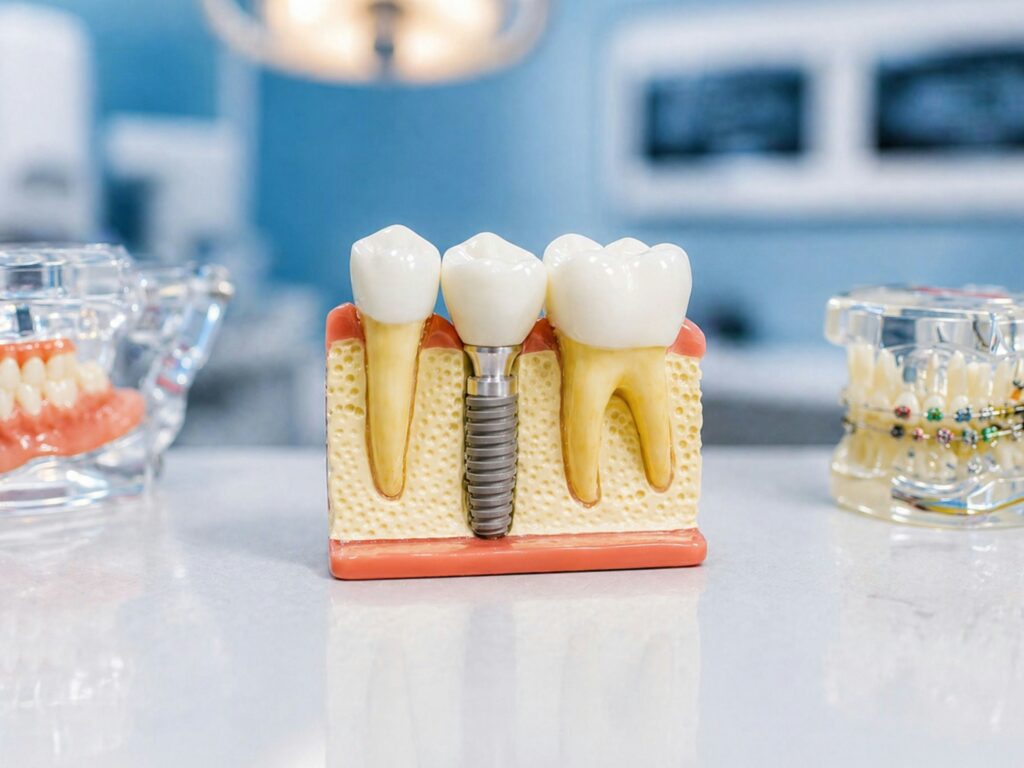
A dental implant is a small titanium post placed in the jawbone where the root used to be. Over a few months, the bone bonds to the post. Then we attach a custom crown, a bridge or a full set of teeth.
Pros
- Looks, feels and chews like a natural tooth
- Stimulates the jawbone, which helps prevent bone loss and the sunken look that can come with missing teeth
- Doesn’t require reshaping healthy neighboring teeth
- Can last for decades with good care
Cons
- Requires minor surgery and a healing period
- Higher upfront cost
- Needs enough healthy bone, though bone grafting can often help
Replacing a full arch? Implant-supported options such as All-on-4 use a few implants to anchor a full set of fixed teeth, with no slipping and no adhesive.
Dental bridges: a fixed, faster option
A bridge fills a gap with a false tooth held in place by crowns on the teeth on either side.
Pros
- Fixed in place, no removal needed
- Faster than implants, usually done in two visits
- No surgery
- Often more likely to be covered by insurance
Cons
- Healthy neighboring teeth must be filed down for crowns
- Doesn’t prevent bone loss under the missing tooth
- Supporting teeth carry extra load and can develop decay at the edges
Dentures: an affordable choice for many missing teeth
Dentures can be full (replacing all teeth on an arch) or partial (filling gaps among natural teeth).
Pros
- The most budget-friendly way to replace many teeth
- No surgery
- Made fairly quickly
Cons
- Removable, and can slip when eating or talking
- Less chewing power than natural teeth or implants
- Don’t stimulate the jawbone, so the fit changes over time and needs relining
The hybrid option: implant-retained dentures snap onto two or more implants. They’re far more stable than traditional dentures and cost less than a full set of fixed implant teeth.
How much do dental implants cost in South Carolina?
Implant cost depends on how many teeth you’re replacing, whether you need extractions or bone grafting, and the type of restoration on top. A single implant usually costs more up front than a bridge or partial denture. But implants may cost less over a lifetime because they rarely need replacing.
At Winyah Dental Group, we give you an itemized estimate after a 3D scan and exam. We’ll also check your insurance benefits and talk through financing options.
Which option is right for you?
Ask yourself:
- How many teeth am I missing? One tooth usually points to an implant or bridge. Many teeth suggest dentures or implant-supported teeth.
- Are the teeth next to the gap healthy? If they’re healthy and unrestored, an implant avoids drilling them down. If they already need crowns, a bridge may make sense.
- How is my bone and gum health? Gum disease needs to be treated first. Read Diabetes and Your Gums {link: Blog: Diabetes and Your Gums} if you have diabetes.
- Do I smoke? Smoking raises the risk of implant failure.
- What matters most to me: lifespan, speed or upfront cost?
Frequently asked questions
Are dental implants better than dentures? For most people who are good candidates, implants offer better comfort, chewing and bone protection. Dentures remain a good, affordable choice for replacing many teeth, especially when combined with implants for stability.
How long do dental implants last? The implant post can last for decades with good care. The crown on top may need replacing after many years of wear.
Is getting a dental implant painful? Implant placement is done with local anesthetic, and many patients say it’s easier than an extraction. We also offer sedation dentistry {link: Sedation Dentistry} for anxious patients.
Does insurance cover dental implants? Coverage varies. Some plans cover part of the implant or the crown. We’ll check your benefits before treatment.
Can I get an implant years after losing a tooth? Often, yes. If the bone has shrunk, a bone graft can rebuild it first.
Book a tooth replacement consultation
Your 2026 dental benefits are already paid for through your premiums, so use them. Request an appointment online, or call our Georgetown office at (843) 545-1295 or our Pawleys Island office at (843) 314-3935.